Yep. That’s me. You’re probably wondering how I got myself into this situation. Well, it all started 7 months ago when I felt this urge of a different summer.
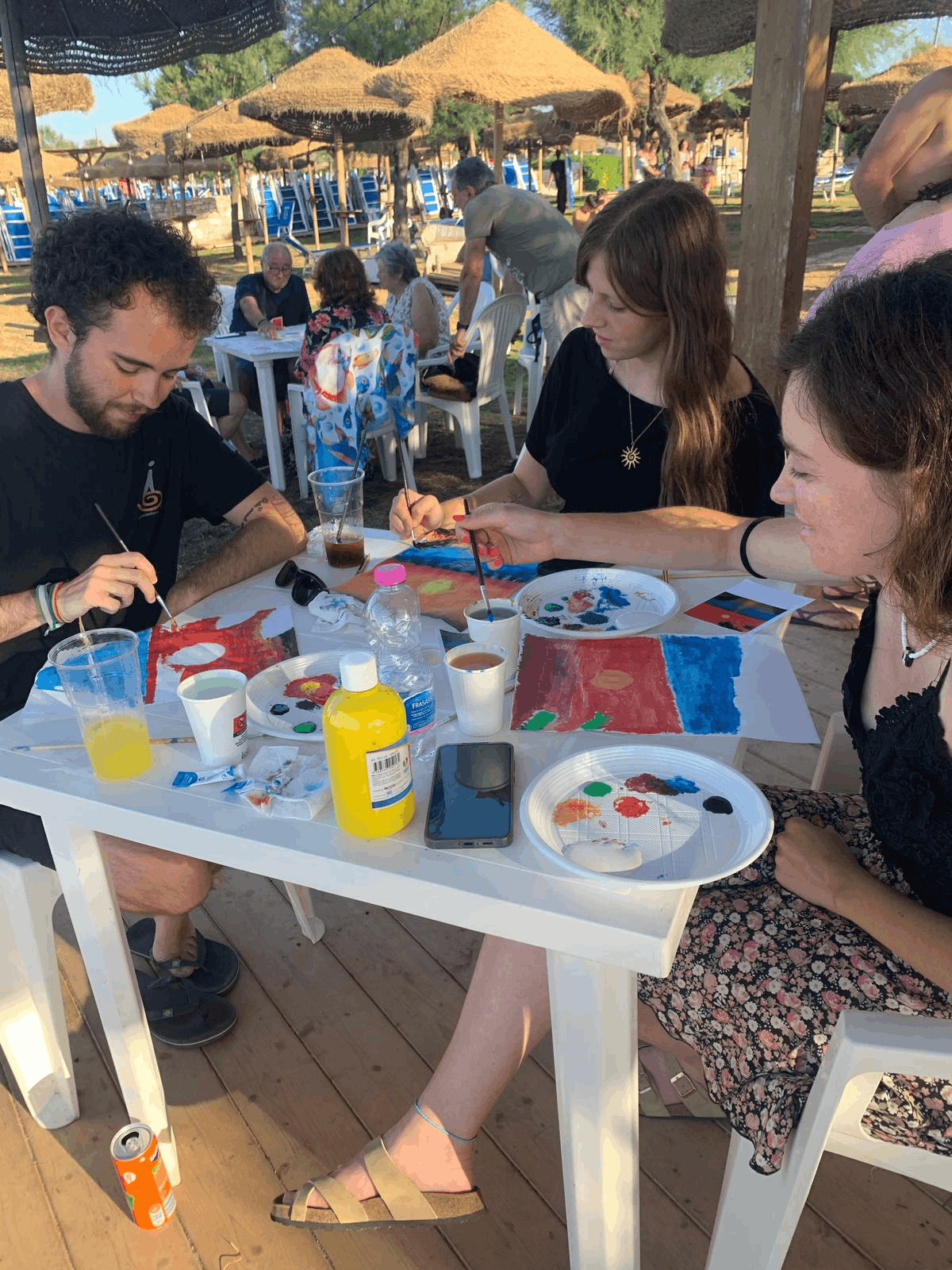
Ciao! My name is Max. I’m a Spanish guy who’s been working at Trullo Beach Club and its summer camp for two months now. I’ve been a Flamenco teacher (Sevillanas, actually, although it was easier to grab the Italians’ attention with this title; they learnt the difference at the end!), a Spanish teacher for kids, and a small-events host.
I was looking for a summer when, while enjoying getting to know a country, its culture, and its language, I could also do my bit for the local community by practising tourism a little more sustainably.
Although at first I felt a bit lost and disappointed because of the expectations I’d had, I’ve learnt that in a volunteering project you’re not on your own. Ever. Other volunteers feel just like you and will join forces to change a situation you don’t agree with. Some coordinators are genuinely committed and will negotiate with whoever is needed to ensure your efforts are recognised and that you’re taken seriously so you can be included. What’s more, you should never feel that you’re not doing enough, because when you least expect it, your tutor will come and tell you how pleased he’s to see that you’ve got so much initiative and are genuinely keen to work. I’ve felt so supported, listened to, understood and relieved.
As well as realising that I’m not alone doing a European voluntary project, I’ve also improved my Italian. I started learning it on my own when I was told I was accepted. However, living and being constantly surrounded by the language is definitely a huge help in improving it and feeling more confident speaking it, because even if you make some mistakes, the locals will do their best to understand you (or at least in Italy) and you will correct those mistakes and learn a lot of daily vocabulary and expressions that you would never learn in a class.
Personally, what I’ve taken away from this experience is that I need to take life more calmly; that everything is a process which doesn’t always go smoothly the first time. Furthermore, my view that there’s nothing to do in small villages has been proven wrong – there are loads of organisations showing local young people that they don’t have to go far to enjoy leisure activities or experience culture. I’m leaving feeling very motivated to find out more about these organisations in my own country and see if I can work with them.
On the other hand, I believe that the impact I’ve had in Molfetta – on children, young people and adults – is a sense of closeness to Spanish culture, both linguistically and musically. Although Italy and Spain are quite similar to each other compared with other northern European countries, I hope I’ve refuted some myths and stereotypes. I also hope to have sparked a curiosity to visit Spain and experience my culture. And who knows? Perhaps by doing some voluntary project, just like me.